
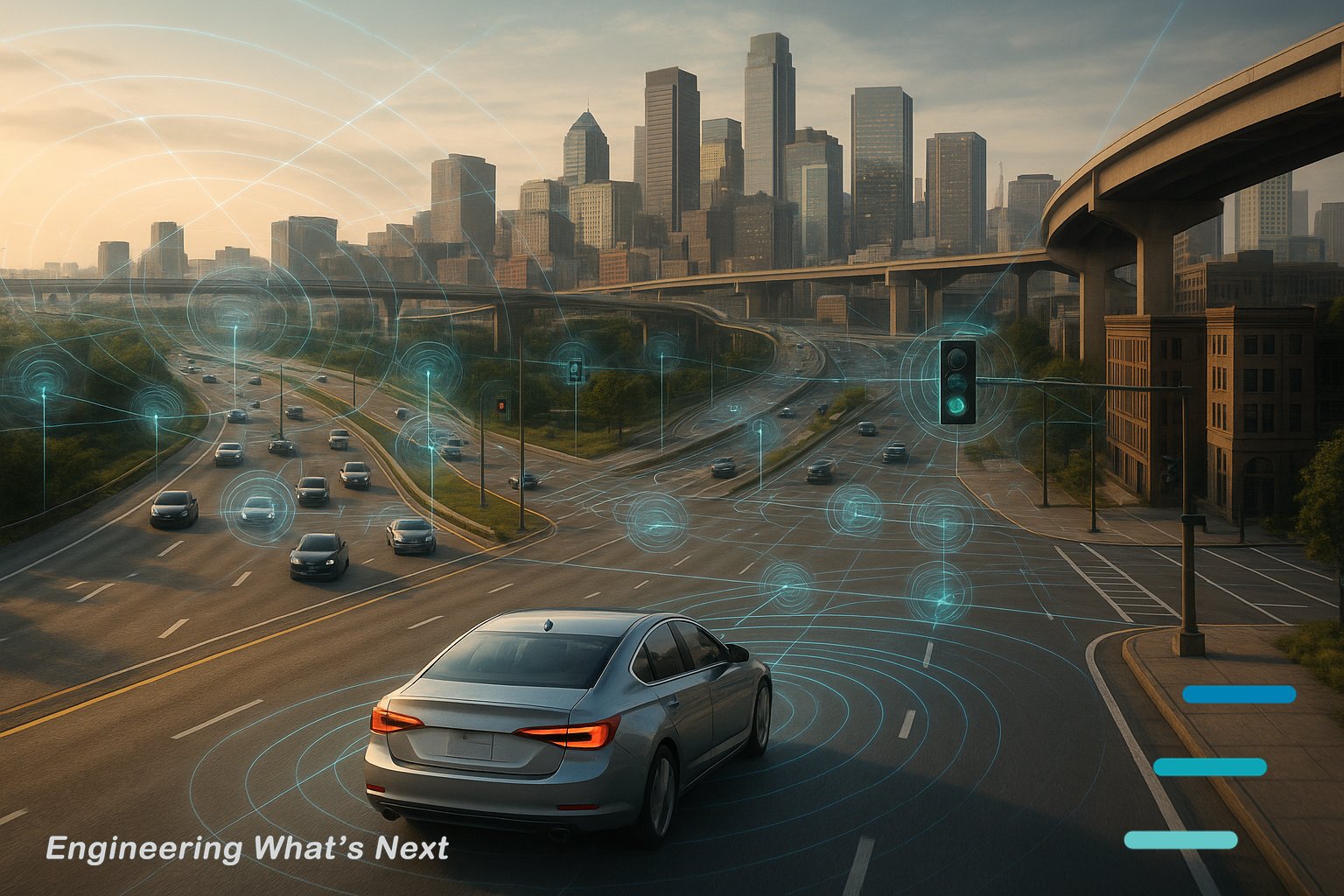
Crossing a state line should not mean crossing into a different digital transportation ecosystem. That sounds obvious until you examine what it would actually take to prevent it, and then the engineering problem becomes one of the most complex in the industry.
On September 3, 2026, USDOT released its National Strategy for Automated Vehicles, establishing a federal direction for FY2026 through 2030. The strategy is organized around five pillars: interoperable transportation corridors across state lines, safety, regulatory certainty, commercial deployment, and national coordination of automated vehicle technology. Read that list carefully. None of those pillars are primarily about the vehicle. Every one of them is fundamentally about the system the vehicle operates within.
That framing matters. It signals a shift in how the federal government is thinking about automated and connected transportation, not as a vehicle technology problem, but as a national infrastructure and interoperability problem. And when you place that strategy alongside USDOT’s existing V2X direction, a larger picture starts to come into focus.
Two National Strategies, One Emerging Architecture
USDOT’s V2X plan, Saving Lives with Connectivity: A Plan to Accelerate V2X Deployment, established a national goal of widespread, secure, and interoperable vehicle-to-everything communication. The $60 million V2X Accelerator program, with deployments underway in Arizona, Texas, and Utah, represents the transition from pilots toward infrastructure that is meant to scale. The program addresses V2X standards, communications architecture, certification frameworks, trust and credential management through the Security Credential Management System, direct short-range communication, and network-based C-V2X connectivity.
The emerging national V2X deployment map is not a collection of independent city projects. It is an attempt to build a foundation for interoperability across vehicles, OEM platforms, transportation agencies, infrastructure vendors, and states. That is an entirely different engineering ambition than a corridor demonstration or an intersection pilot.
Now place the September 2026 AV strategy on top of that foundation. Interoperable corridors across state lines require that an automated vehicle operating in Arizona does not lose situational awareness when it crosses into Utah. That requirement connects directly to the V2X infrastructure those states are deploying. The two strategies are not parallel. They are converging.
Three Technology Movements Arriving at the Same Intersection
What makes this moment genuinely different from the last decade of connected vehicle discussions is that three large technology movements are now developing simultaneously, and each one is accelerating independently.
The automotive industry is moving toward software-defined vehicles. OEMs are rebuilding electrical architectures around centralized compute, service-oriented software, and over-the-air update capability. Vehicles are becoming software platforms as much as they are mechanical products.
USDOT and state DOTs are building connected infrastructure. Roadside units, signal phase and timing data, work zone alerts, wrong-way vehicle detection, pedestrian and cyclist awareness systems, and real-time incident notification are being deployed at scale. Transportation agencies are becoming data publishers in ways they have never been before.
Cities and regional transportation systems are becoming increasingly data-driven. Traffic management centers are gaining real-time visibility into conditions that were invisible a decade ago. Edge computing is moving intelligence closer to the roadway. Cloud platforms are aggregating transportation data at regional and national scale.
USDOT has not created a national software-defined vehicle program or a national smart city program. That distinction is important to state clearly. What USDOT is doing is building national strategies around interoperable connected and automated transportation infrastructure. The SDV movement is driven by OEMs and their software supply chains. The smart city and connected agency movement is driven by municipalities, regional planning organizations, and state DOTs.
The question worth asking is what happens when all three arrive at the same place at the same time.
The Interoperability Problem at National Scale
A V2X application working reliably at one instrumented intersection is a meaningful engineering achievement. A connected transportation ecosystem expected to work across cities, states, infrastructure vendors, vehicle manufacturers, and technology platforms is a fundamentally different problem.
Consider what national-scale interoperability actually requires:
- A software-defined vehicle from one OEM must correctly interpret MAP and SPaT messages broadcast by roadside units from multiple infrastructure vendors running different firmware versions.
- Trust and credential validation through the SCMS must function without latency that degrades the safety application.
- A work zone alert generated by a state DOT system must be normalized, transmitted, and acted upon by an automated driving system that was developed with no knowledge of that state’s specific data format choices.
- Edge systems operating at the roadside must integrate with cloud platforms aggregating data at regional scale, and that integration must be reliable enough for safety-relevant applications.
- When a vehicle crosses a state line, the handoff between jurisdictions cannot introduce a gap in the vehicle’s awareness of roadway conditions.
Each of those requirements involves software integration across systems that were developed independently, by different organizations, to different standards, on different timelines. The SAE message set standards, the IEEE 802.11p and C-V2X communications specifications, the NTCIP standards for traffic management, and the emerging API frameworks for data exchange all establish common languages. But a common language and a working conversation are not the same thing. Translation, normalization, validation, and latency management are engineering work that happens between the standards and the deployed system.
Security compounds every layer. The threat surface for a nationally connected transportation system is not comparable to a single intersection deployment. Credential management, message authentication, anomaly detection, and the operational monitoring needed to identify misbehaving devices in the field are all problems that grow nonlinearly with deployment scale.
Where the Digital Architecture Becomes the Story
The biggest transportation technology story of this period may no longer be the vehicle, the road, or the smart city independently. It may be the digital architecture connecting all three.
When a software-defined vehicle moves through a transportation environment that can communicate signal phase and timing, curve speed warnings, work zone geometry, emergency vehicle approach, pedestrian presence, and real-time incident conditions, the vehicle’s onboard systems are no longer operating only on sensor data. They are operating on a shared situational awareness that extends beyond what any camera, radar, or lidar system can resolve on its own. That changes what automated driving can do and where it can operate safely.
But that capability depends entirely on the integrity of the data pipeline from the infrastructure to the vehicle. Message latency, data normalization, authentication, and the reliability of the edge and cloud systems carrying that information are not secondary concerns. They are the enabling conditions for the safety case.
This is where Echelle’s work is concentrated. Not in the manufacture of roadside hardware or vehicle sensors, but in the software integration, application development, validation, and connected architecture that determines whether independently developed systems can actually communicate with the reliability that safety-relevant applications demand. The engineering teams evaluating partners for V2X application development, software-defined vehicle integration, and connected infrastructure projects will find context for what that work involves at echelleresources.com. For those who want to discuss a specific program or architecture challenge directly, a conversation is straightforward to arrange at this link.
The Question That Deserves a Serious Answer
USDOT’s September 2026 AV strategy calls explicitly for interoperable transportation corridors across state lines. The V2X Accelerator is building the connectivity foundation in three states. OEMs are developing software-defined vehicles on independent platforms with independent data architectures. State DOTs are deploying infrastructure to standards that are still evolving. Cities are building data environments that were not designed with vehicle integration in mind.
Given that the vehicles, the infrastructure, and the data environments connecting them are all being developed by different organizations to different timelines and different specifications, what governance structure, technical authority, and validation methodology would actually be capable of certifying that a connected automated vehicle is operating on trustworthy data as it moves across the full corridor from Phoenix to Salt Lake City, and who is accountable when that assurance fails?
#V2X #ConnectedVehicles #SoftwareDefinedVehicle #ConnectedInfrastructure #IntelligentTransportationSystems #CAV #AutomotiveSoftware #SmartMobility

